Categories
budget economics Key Article problems WellFair

Why WellFair Works Fair

The welfare debate has become confused and poisonous. We are firmly in the territory of “deserving” versus “undeserving” poor, when the real issue is affordability. As all advanced societies start to grapple with the challenge of how to run a peaceful, modern society within the confines of a low growth economy and within a sustainable budget, we need to develop a vision for how social security will work in that environment.

It is commonly recognised that the delta between income and the cost of living is the problem, but reducing the cost of living is virtually never discussed as an option to solve this problem. This is a blind spot obscuring the key to sustainable and affordable human society.

Solving the welfare conundrum has been a central mission of LIFE. So here we will review what we are really seeking to achieve with welfare, what has gone wrong, and how we can reach our objectives.

Categories
budget debt economics problems WellFair

We have to solve the real problems

The real problem is that we are not running a working system.

  • Not economically or financially.
  • Not socially.
  • Not environmentally.

Economically we are not balancing our books, and using debt to plug the gap. And we are paying millions of people to do nothing, in a society were simply existing is expensive, financially and environmentally.

Socially we are not nurturing the cohesion, understanding and specialist skills we need.

Environmentally we are not moving off fossil fuels fast enough.

We are still in the process of figuring out how to make it all work. How to provide a decent standard of life, how to do that in line with a working economic system, and have that system provide enough room to invest in future infrastructure that is sustainable.
We, obviously, have not figured out the big stuff yet.

Collecting taxes to pay for social security and fund national infrastructure looked like the solution. But that was back in the beginning of the 20th C when resources were cheap and demographics were in a special state. Now resources are expensive and we are arriving at a natural demographic balance.
Taxes alone will not generate sufficient revenues to pay for our society and the investments we need to make. This has been true for 50 years. We need to face his fact.

  • GDP growth is not the answer because we still have an old economy based on fossil fuels, and an old structure that suppresses sustainable micro-economic activity.
  • Increasing wages is not an answer either. It does not address any of the major problems, it is not practical, and it assumes there is enough wealth to pay for all our needs. But as we have already said, we have higher social needs (with progressive demographics) than our economy can afford to generate taxes to pay for.
  • Increasing taxes will not do it either. We are already close the maximum tax rate an economy can withstand before it starts contracting. Some increase is possible, but it’s not enough to bridge the gap between our needs and our resources.

How do you meet expanded social needs at the same time as investing in the future, when you’re not generating enough taxes already?

You revert the social contract to its natural state.
The social contract over the long arc of human history has always been to guarantee a basic, decent life to all members of the group. We need to revive that contract. The social contract is not about money, it’s about a decent LIFE. The social contract is a guarantee of services, not cash. A guarantee of shelter, sustenance and access to basic services such as transport, health care and education.

Reverting to the natural social contract has a transformative effect on our finances. It reduces the cost of life, and it makes investment more affordable. It does this because it costs us less, as a society, to deliver basic life services than it does for each individual to buy the same services on their own. Every £1 it costs us to deliver basic services is worth 3 or 4 times as much to the recipient. So we trade pay for services, which reduces the cost of the services, which in turn means that we have to raise less taxes to pay for the same amount of service.

A natural social contract delivers better services, to more people, at lower cost. It brings our finances into balance, using a reasonable tax to fund affordable services. And it makes investment cheaper by lowering the cost of basic labour. Finally, and most importantly, it changes the relationship to work, from one of coercion for survival, to one of voluntary contribution for reward.

All this requires surprising little change and upheaval. We simply need to spend 3 years rolling out local community services for free food, local transport, Internet and basic phone services. These compliment the existing free healthcare, education and shelter services that we already provide. The rest of the benefits flow naturally without legislation. Wages fall of their own accord, micro-businesses start on their own, and the benefits of efficient resource use accrue naturally.

Making these changes is what LIFE is all about. We are about facing the big and real problems, and delivering solutions that will take us through a period of change as gently and peacefully as possible.

Categories
debt economics problems WellFair

Understanding Affordable Social Democracy

The great challenge of the 21st century: How do we organise a society that is both sustainable and affordable?

To understand the origin of this problem, please read this first.

Looking for a 1 page summary? Download Affordable Social Democracy.

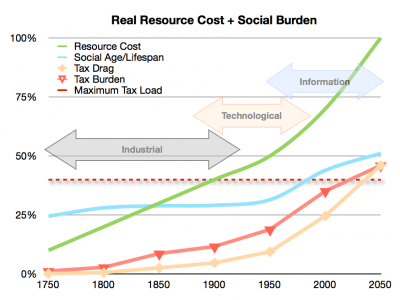
The chart below presents the factors contributing to the challenge, see below for detailed explanations.

understanding

What this shows is that the tax burden on the economy will inevitably exceed is maximal percentage as our population ages, unless the percentage of total activity in the society that is monetised is reduced.
In short: some services have to be exchanged for free, otherwise you go broke trying.

Blue line: Social Age/Lifespan
As human society passes through the 3 revolutions (Industrial, Technological and Information) it levels off and reaches a more stable balance of young and old in proportion to working age adults.
At the end the percentage of able and working age is a minority.

Green line: Resource Cost
This represents the percentage of the true cost of a resource that is reflected in it’s economic price. As human societies across the world all start their progression through the revolutions, and as the “externalities” of resource use manifest, the greater the percentage of the true cost of a resource gets incorporated in it’s economic price. Low values represent high exploitation.
This line could even go above 100% in the near future, as we have to recoup expenses related to previously unpaid-for externalities that come home to roost, such as climate change mitigation costs.

Red line: Tax Burden
The Tax Burden represents the monetary cost to the economy of meeting the social needs of the society. This increases with 2 factors:

  • Social lifespan – the percentage of a life spent maturing and ageing
  • Monetary Penetration – the extent to which total activity in the society is monetised, specifically the attribution of monetary values to services

Orange line: Tax Drag
This line compensates the tax effect on the economy by the extent to which true costs are incorporated in resource prices. While resources are available at below true cost (exploitation), the economy does not have to work as hard to generate the wealth to cover the tax burden. As the Resource Cost increases, the economy has to work harder to produce the same amount of wealth.

Max_commercial

Most factors are outside our control, demographic changes and resource cost increases are basically fixed, the only factor within our control that can make a difference is monetary penetration (the percentage of total activity that is paid for with money). If as much activity as possible is pushed into the wealth economy and exchanged for money, the correlated tax burden on the wealth economy has to exceed it’s optimal maximum of around 40%.

On the other hand, if monetary penetration is kept below 80% in a society with 50%+ dependency, then tax rates can be restrained to the 40% maximum. Even better would be to push monetary penetration down to 70%, at which point the tax burden is under 36%.
See table: There is a direct relationship between dependency ratios and tax rates. In this table blue=capitalist, green/yellow=social, red=communist. Pick your tax rate and you can see which social system you need to have to make that tax rate possible.

If you live in a society with 50%+ dependency, the key is to have at least one fifth of all activity in “not paid for in cash”. Ever since the industrial revolution we have pushed to have more and more activity “monetised” (paid for with money), and therefore part of the society’s GDP, measured in money. That works fine while the majority of all activity is productive, (i.e. you don’t have a lot of old and young people) because taxes are a proportion of the money economy, and when the money economy is growing tax revenues rise faster than the increased expense caused by having more activity monetised. However once the majority of the population is dependent (i.e. lots of old and young people), having more activity monetised increases expenses more than it increases tax revenues.

The way to push monetary penetration down is to deliver social security as free, non-means-tested, universal services. This works to socialise the most basic portion of labour cost, because it is exchanged in an unconscious barter for the value of the services.


Data Table

Notes

1750

1800

1850

1900

1950

2000

2050

Social Activity (Barter)

% of total activity that is exchanged without cash

95%

90%

70%

60%

40%

20%

10%

Commercial Activity (Paid)

% of total activity that is paid for in cash/credit

5%

10%

30%

40%

60%

80%

90%

Avg Lifespan

45

46

47

47

70

82

90

Productive Start Age

12

14

15

16

17

20

23

Productive End Age

45

46

47

47

65

66

67

Working Age/Life

73%

70%

68%

66%

69%

56%

49%

Social Age/Lifespan

27%

30%

32%

34%

31%

44%

51%

Resource Cost

Actual cost relative to true/free cost

10%

20%

30%

40%

50%

70%

100%

Labour Production Effort

Working lifespan contribution factored by actual cost

733%

348%

227%

165%

137%

80%

49%

Economy Size (UK)

BoE Real GDP UK (1850+)

100

225

548

1,854

13,308

976,533

2,000,000

Underlying Economy (Real Effort)

Real economic effort, as if resources were true cost

10

45

164

742

6,654

683,573

2,000,000

Social Cost

Cost of providing for social lifespan on underlying economy factoring % of activity that is paid for

0

1

16

101

1,255

240,084

920,000

Tax Drag

Tax rates factored by Resource Cost

0.13%

0.61%

2.87%

5.45%

9.43%

24.59%

46.00%

Social Cost II

Cost of providing for social lifespan at actual resource cost factoring % of activity that is paid for

1

7

52

252

2,510

342,977

920,000

Tax Burden

Nominal tax rates for social costs

1.33%

3.04%

9.57%

13.62%

18.86%

35.12%

46.00%

Maximum Tax Burdens
There is a fair amount of research on the issue of the maximum tax burden that an economy can sustain before the effect becomes negative on the performance of the economy. To make a determination on a simpler basis, we can just look at the
current tax rates for various countries around the world.

  • Top 10 Highest Tax Countries (includes all the Scandavian): average 45%
  • Top 50 Highest Tax Countries: average 37%


Economically Active Ages

IMG_0141

Categories
labour WellFair

Living Wage Commission Submission

Dear Commission,

We would like to thank the Archbishop and the other members of the commission for establishing this important and urgent enquiry into the structure and the future of our societies.

Please find attached the submission to your commission from the LIFE Party.

In the submission we establish that the direction accomplishment of our stated objectives of a just and good society, delivers a much more effective solution than attempts to set wages. And universal services provide enormous economic benefits for our society that are not available through the pursuit of the same objectives via the means of wage manipulation.

We would also be happy to provide oral evidence to the commission should you wish.
The details behind the summary on the attached document can be found at http://www.uklife.org/wellfair.

LIFE, July 2013


Living wage – a fatal distraction

Solving the problem of affordable social democracy

The desire to impose a living or minimum wage on the economy is merely a substitute for the provision of the universal social support that is our real responsibility. The intention to assert a minimum or living wage both involve coercion, one of the provider of labour, and the other of the employer.

A Standard of life
The real objective
In the pursuit of a “living wage” we must first acknowledge that our real objective is the support of a basic standard of life for all members of our community and society. What we are seeking is the creation of a floor to living standards that defines our social contract, a minimum standard of life below which we will not let our neighbours fall. That social contract is properly defined in terms of shelter, sustenance and basic services such as health, care, education and information access.
We only use money as a substitute measure when we imagine that we cannot deliver the services themselves. But this is only a failure of imagination and effort – there is no real, practical barrier to delivering all basic needs as services.

Losing before we start
If we define the quality of life in money, we have lost the battle before the battle has begun. The pursuit of a living wage, defined in monetary terms, is a distraction from the true goal. The pursuit of a living wage is to entrust Caesar with responsibilities that are not his, and which he cannot be held to.

Naturally efficient
Universal services automatically prioritise efficient use of resources, because they tend naturally toward the lowest cost means of delivering the services to everyone.

So Nearly there
We already deliver much of the social contract as services
In the UK we already provide free access to health and education to everyone, and we provide free shelter, transport and sustenance for subsets of our society.
We can extend the basic services to every person in need of them with little additional effort, and no additional cost in the medium term. We spend £500Bn a year on social services today, and the same budget will allow us to deliver the services universally, after removing the waste and overhead of centrally-administered, means-tested benefit programs. See uklife.org/wellfair-budget for detailed costing using JRF MIS.
A free bus pass for everyone, community kitchens providing locally-sourced, healthy food, and basic phone & Internet will do it!

Economic emancipation
Growth and prosperity unleashed
When we deliver on our social contract with services, we liberate everyone to participate in the wealth economy at the level and pace that they desire – without coercion of either labour or employer. Universal services eliminate the “benefit trap” caused by means-testing, and reinforce the incentive to contribute.
Free local transport and enhanced communications are lifeblood to small and micro businesses. Flexible, socially secure labour is a boon to all enterprise.
A million micro economic contributions are liberated, enriching our lives, demoting consumption and adding economically valuable activity that is otherwise left undone.

No subsidy necessary
Once we take responsibility for delivering our social contract, we will not have to subsidise businesses to create employment. Businesses will have to offer sufficiently attractive pay and conditions to attract workers in a functioning market.

Labour costs
Reduced labour rates make infrastructure investments affordable
Whereas the enforcement of minimum wages push up the monetary costs of investment, providing universal services reduces the cost of labour, in monetary terms, and makes building new housing, upgrading our energy infrastructure, and other social investments more affordable from a reasonable tax on wealth.


“Just and Good Society”
Eyes on the prize! It is the just and good society that we seek, and it is only the trance of money that leads us to describe the objective in terms of money. Solving the problem of how to deliver affordable social security is not only an economic imperative, it will also deliver the broad social justice we are seeking.

“Why aren’t those who are profiting from their workers paying up?”
It is illogical to ask a profit-orientated corporation to voluntarily increase its costs. It’s like asking a snake to jump. 
It is our responsibility, as fellow citizens, to meet our own social needs. We are society, we are the ones in charge!

“At the end of the day, what workers really need is pay, not platitudes.”
Not true. At the end of the day, what everyone really needs is community, not cash. We must shed our illusion that cash can replace a social bond that recognises and respects our mutual interdependence.

Economic suicide
Our economy has been seriously destabilised by futile attempts to replace real security rooted in a social contract, with the false security of material wealth. 
The reason we rescued the banks in 2008 was to protect the money in pensions. The reason we are inflating house prices and stock markets now is to use cash to try and create employment and rebuild social fabric.
We simply cannot force our economy to do our social work.




Categories
competition enterprise problems WellFair

Proper Privatisation

The proper role of private enterprise in the delivery of public services is to improve the services.

Private enterprise is dependent on the existence of competition, risk and reward to function properly.

No public service should be controlled and managed by private enterprise unless competition, risk and reward are present. All private enterprise involvement in public services must remain democratically accountable.

Categories
crisis debt economics WellFair

Black & White

We have three crises today: an economic crisis, a social crisis and a climate crisis.

In the UK the economic crisis is that we are borrowing £2 an hour, for every hour worked by every man and woman in employment. That’s new borrowing every hour worked by every person in the country – and that is with “austerity”.

The social crisis is that, despite not being able to afford the services we already have, those services are not good enough and not meeting the needs. We are not building the cohesive, educated and participatory citizenry necessary to sustain our complex, modern society.

The climate crisis is that our unaffordable and ineffective society is also borrowing from the natural world around us, when we are ready overdrawn on that account. This debt cannot be “written down” or “forgiven”, it must be paid. We have the technology to solve the climate crisis, and the resources to solve the social crisis, what is missing is an economic model that allows that to become a reality.

The current economic model is preventing us from solving the social and climate crises. The LIFE economic model is the key to unlocking our potential and to solving these crises. BY REPLACING CASH DISTRIBUTIONS WITH WELLFAIR SERVICES WE CAN ENSURE THAT WE DO BUILD A COHESIVE, EDUCATED AND PARTICIPATORY CITIZENRY. Wellfair reduces the cost of delivering social services, and automatically promotes sustainable resource use.

We have three crises and one solution – the choice is ours. The switch to wellfair will require everyone to participate more, and it will not be without its winners and losers. The alternative is a downward spiral of debt, social disintegration and further climate instability.

The choice is yours to make, and now is the only time that you can make it.