Categories
debt economics problems WellFair

Understanding Affordable Social Democracy

The great challenge of the 21st century: How do we organise a society that is both sustainable and affordable?

To understand the origin of this problem, please read this first.

Looking for a 1 page summary? Download Affordable Social Democracy.

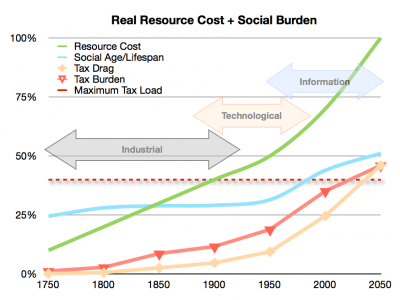
The chart below presents the factors contributing to the challenge, see below for detailed explanations.
understanding

What this shows is that the tax burden on the economy will inevitably exceed is maximal percentage as our population ages, unless the percentage of total activity in the society that is monetised is reduced.
In short: some services have to be exchanged for free, otherwise you go broke trying.

Blue line: Social Age/Lifespan
As human society passes through the 3 revolutions (Industrial, Technological and Information) it levels off and reaches a more stable balance of young and old in proportion to working age adults.
At the end the percentage of able and working age is a minority.

Green line: Resource Cost
This represents the percentage of the true cost of a resource that is reflected in it’s economic price. As human societies across the world all start their progression through the revolutions, and as the “externalities” of resource use manifest, the greater the percentage of the true cost of a resource gets incorporated in it’s economic price. Low values represent high exploitation.
This line could even go above 100% in the near future, as we have to recoup expenses related to previously unpaid-for externalities that come home to roost, such as climate change mitigation costs.

Red line: Tax Burden
The Tax Burden represents the monetary cost to the economy of meeting the social needs of the society. This increases with 2 factors:

  • Social lifespan – the percentage of a life spent maturing and ageing
  • Monetary Penetration – the extent to which total activity in the society is monetised, specifically the attribution of monetary values to services

Orange line: Tax Drag
This line compensates the tax effect on the economy by the extent to which true costs are incorporated in resource prices. While resources are available at below true cost (exploitation), the economy does not have to work as hard to generate the wealth to cover the tax burden. As the Resource Cost increases, the economy has to work harder to produce the same amount of wealth.

Max_commercial

Most factors are outside our control, demographic changes and resource cost increases are basically fixed, the only factor within our control that can make a difference is monetary penetration (the percentage of total activity that is paid for with money). If as much activity as possible is pushed into the wealth economy and exchanged for money, the correlated tax burden on the wealth economy has to exceed it’s optimal maximum of around 40%.

On the other hand, if monetary penetration is kept below 80% in a society with 50%+ dependency, then tax rates can be restrained to the 40% maximum. Even better would be to push monetary penetration down to 70%, at which point the tax burden is under 36%.
See table: There is a direct relationship between dependency ratios and tax rates. In this table blue=capitalist, green/yellow=social, red=communist. Pick your tax rate and you can see which social system you need to have to make that tax rate possible.

If you live in a society with 50%+ dependency, the key is to have at least one fifth of all activity in “not paid for in cash”. Ever since the industrial revolution we have pushed to have more and more activity “monetised” (paid for with money), and therefore part of the society’s GDP, measured in money. That works fine while the majority of all activity is productive, (i.e. you don’t have a lot of old and young people) because taxes are a proportion of the money economy, and when the money economy is growing tax revenues rise faster than the increased expense caused by having more activity monetised. However once the majority of the population is dependent (i.e. lots of old and young people), having more activity monetised increases expenses more than it increases tax revenues.

The way to push monetary penetration down is to deliver social security as free, non-means-tested, universal services. This works to socialise the most basic portion of labour cost, because it is exchanged in an unconscious barter for the value of the services.


Data Table

Notes

1750

1800

1850

1900

1950

2000

2050

Social Activity (Barter)

% of total activity that is exchanged without cash

95%

90%

70%

60%

40%

20%

10%

Commercial Activity (Paid)

% of total activity that is paid for in cash/credit

5%

10%

30%

40%

60%

80%

90%

Avg Lifespan

45

46

47

47

70

82

90

Productive Start Age

12

14

15

16

17

20

23

Productive End Age

45

46

47

47

65

66

67

Working Age/Life

73%

70%

68%

66%

69%

56%

49%

Social Age/Lifespan

27%

30%

32%

34%

31%

44%

51%

Resource Cost

Actual cost relative to true/free cost

10%

20%

30%

40%

50%

70%

100%

Labour Production Effort

Working lifespan contribution factored by actual cost

733%

348%

227%

165%

137%

80%

49%

Economy Size (UK)

BoE Real GDP UK (1850+)

100

225

548

1,854

13,308

976,533

2,000,000

Underlying Economy (Real Effort)

Real economic effort, as if resources were true cost

10

45

164

742

6,654

683,573

2,000,000

Social Cost

Cost of providing for social lifespan on underlying economy factoring % of activity that is paid for

0

1

16

101

1,255

240,084

920,000

Tax Drag

Tax rates factored by Resource Cost

0.13%

0.61%

2.87%

5.45%

9.43%

24.59%

46.00%

Social Cost II

Cost of providing for social lifespan at actual resource cost factoring % of activity that is paid for

1

7

52

252

2,510

342,977

920,000

Tax Burden

Nominal tax rates for social costs

1.33%

3.04%

9.57%

13.62%

18.86%

35.12%

46.00%

Maximum Tax Burdens
There is a fair amount of research on the issue of the maximum tax burden that an economy can sustain before the effect becomes negative on the performance of the economy. To make a determination on a simpler basis, we can just look at the
current tax rates for various countries around the world.

  • Top 10 Highest Tax Countries (includes all the Scandavian): average 45%
  • Top 50 Highest Tax Countries: average 37%


Economically Active Ages

IMG_0141

Categories
economics problems taxes

Perfectly understandable

We don’t pay for everything today, we can’t pay for everything today, and it was never true that we would be able to pay for everything.
We were slightly distracted on our journey from pre-revolution to post-revolution into thinking that our reality was defined by the 3 revolutions (industrial, technological and information). We are still humans, and the revolutions were only changes to our methods, not our natures. Our reality was before, and remains today, that of a social, group animal surviving on a finite planet through our mutual exchange of support.

In pre-revolutionary society (pre-1840) the vast majority of people survived almost exclusively through the mutual exchange of support. There was never enough commercial activity to even consider paying for mutual social security, it had to be bartered for. The 3 revolutions transformed our ability to generate commercial activity. In a span of only 150 years (1840-1990) we expanded the percentage of total human activity that was commercial in nature from a small minority, to what seemed to be almost total encompassment. The speed and breadth of the revolutions almost blinded us to our reality, the reality of interdependence that we are now re-facing as we emerge into the post-revolutionary world.

For the short period when a society is in the midst of its revolutionary progression, it naturally has a population that consists mostly of working age adults, before the effects of advanced healthcare have kicked in, and before the information revolution requires the extended incubation of advanced education. During this mid-revolutionary phase the society can pay for its limited social needs by taxing the expanding economy.

Early adopter societies, entering the revolutionary cycle before the majority of other societies have started, can also exploit under-priced resources abroad, and create an over-sized economy that allows the increasing social burden of its maturing demographic to be paid for out of a tax on its inflated economy.

understandingBut once the majority of societies have entered the revolutionary cycle it is not possible to maintain an exploitation-inflated economy, because resources are no longer available at below true value.

A mature post-revolutionary society has a minority working age population and an economy that, while greatly enlarged from its pre-revolutionary state, is still a minority of total activity. At this point, a tax on the economy high enough to pay for the social needs will reduce economic performance, creating a downward spiral.

This looks like a big problem. But in fact it is just the re-emergence of a truth that was always there: no matter how blindingly brilliant the 3 revolutions have been, they did not change the basic truth about our nature: we are a group, social species, dependent on our group for our individual survival, and visa versa.

There has always been a massive amount of activity in our group that was never “paid” for, and it could never be afforded from a tax on commerce. Only the short period in the evolution of a society through its revolutionary cycle, when working age populations are high, supports an illusion that we can buy our way out of our interdependence.

The “first world” in the 20th C was not at a destination, it was simply a stage in motion through the natural progression to a normalised demographic, in a resource-constrained world. Human populations naturally resolve into quite likeable and practical distributions, as birth rates fall off with increased security. The pricing of finite resources naturally resolve to comply with the closed-circuit reality of our planet. This normalised reality is not a problem, it has ample opportunity for greater joy, but it does require us to recognise and accept our situation. We do not live lives defined by the value of commerce (revolutionary activity), nor are we limited by the taxes we can impose on commerce. The only real limit we face is that of finite resources.

Our reality is the same as it ever was: the majority of our activity is social, a barter between humans for services. A minority of the activity in an advanced human society is commercial, and that’s OK.

We cannot abandon the revolutions, our enlarged populations are entirely dependent on the continuing practice of industrial, technological and information activity. But our dependence on them is purely practical. Revolutionary activity is contextual to our desires, and our desires are human. Defined as “joy”, we seek and find reward to interconnection and interaction on a human level, commerce is merely an enabling method. The future of humanity depends on accepting our social nature and leveraging the revolutions.
The way to accomplish this unification is to accept our mutual social contract for support services, and welcome the functional contributions of the revolutions while rejecting their dysfunctional elements. Industry, technology and information are all good when filtered through understanding of their roles in support of human society. The two primary requirements this understanding gives us are:

  • our success is based on the wondrous specialisation we can support within our groups
  • we live on a finite planet.

The aspects of the revolutions that support specialisation and sustainability are invaluable. Industrial, technological and information processes that denigrate specialisation or sustainability can be comfortably jettisoned.

For data and analysis of tax rates, see here.

Categories
labour WellFair

Living Wage Commission Submission

Dear Commission,

We would like to thank the Archbishop and the other members of the commission for establishing this important and urgent enquiry into the structure and the future of our societies.

Please find attached the submission to your commission from the LIFE Party.

In the submission we establish that the direction accomplishment of our stated objectives of a just and good society, delivers a much more effective solution than attempts to set wages. And universal services provide enormous economic benefits for our society that are not available through the pursuit of the same objectives via the means of wage manipulation.

We would also be happy to provide oral evidence to the commission should you wish.
The details behind the summary on the attached document can be found at http://www.uklife.org/wellfair.

LIFE, July 2013


Living wage – a fatal distraction

Solving the problem of affordable social democracy

The desire to impose a living or minimum wage on the economy is merely a substitute for the provision of the universal social support that is our real responsibility. The intention to assert a minimum or living wage both involve coercion, one of the provider of labour, and the other of the employer.

A Standard of life
The real objective
In the pursuit of a “living wage” we must first acknowledge that our real objective is the support of a basic standard of life for all members of our community and society. What we are seeking is the creation of a floor to living standards that defines our social contract, a minimum standard of life below which we will not let our neighbours fall. That social contract is properly defined in terms of shelter, sustenance and basic services such as health, care, education and information access.
We only use money as a substitute measure when we imagine that we cannot deliver the services themselves. But this is only a failure of imagination and effort – there is no real, practical barrier to delivering all basic needs as services.

Losing before we start
If we define the quality of life in money, we have lost the battle before the battle has begun. The pursuit of a living wage, defined in monetary terms, is a distraction from the true goal. The pursuit of a living wage is to entrust Caesar with responsibilities that are not his, and which he cannot be held to.

Naturally efficient
Universal services automatically prioritise efficient use of resources, because they tend naturally toward the lowest cost means of delivering the services to everyone.

So Nearly there
We already deliver much of the social contract as services
In the UK we already provide free access to health and education to everyone, and we provide free shelter, transport and sustenance for subsets of our society.
We can extend the basic services to every person in need of them with little additional effort, and no additional cost in the medium term. We spend £500Bn a year on social services today, and the same budget will allow us to deliver the services universally, after removing the waste and overhead of centrally-administered, means-tested benefit programs. See uklife.org/wellfair-budget for detailed costing using JRF MIS.
A free bus pass for everyone, community kitchens providing locally-sourced, healthy food, and basic phone & Internet will do it!

Economic emancipation
Growth and prosperity unleashed
When we deliver on our social contract with services, we liberate everyone to participate in the wealth economy at the level and pace that they desire – without coercion of either labour or employer. Universal services eliminate the “benefit trap” caused by means-testing, and reinforce the incentive to contribute.
Free local transport and enhanced communications are lifeblood to small and micro businesses. Flexible, socially secure labour is a boon to all enterprise.
A million micro economic contributions are liberated, enriching our lives, demoting consumption and adding economically valuable activity that is otherwise left undone.

No subsidy necessary
Once we take responsibility for delivering our social contract, we will not have to subsidise businesses to create employment. Businesses will have to offer sufficiently attractive pay and conditions to attract workers in a functioning market.

Labour costs
Reduced labour rates make infrastructure investments affordable
Whereas the enforcement of minimum wages push up the monetary costs of investment, providing universal services reduces the cost of labour, in monetary terms, and makes building new housing, upgrading our energy infrastructure, and other social investments more affordable from a reasonable tax on wealth.


“Just and Good Society”
Eyes on the prize! It is the just and good society that we seek, and it is only the trance of money that leads us to describe the objective in terms of money. Solving the problem of how to deliver affordable social security is not only an economic imperative, it will also deliver the broad social justice we are seeking.

“Why aren’t those who are profiting from their workers paying up?”
It is illogical to ask a profit-orientated corporation to voluntarily increase its costs. It’s like asking a snake to jump. 
It is our responsibility, as fellow citizens, to meet our own social needs. We are society, we are the ones in charge!

“At the end of the day, what workers really need is pay, not platitudes.”
Not true. At the end of the day, what everyone really needs is community, not cash. We must shed our illusion that cash can replace a social bond that recognises and respects our mutual interdependence.

Economic suicide
Our economy has been seriously destabilised by futile attempts to replace real security rooted in a social contract, with the false security of material wealth. 
The reason we rescued the banks in 2008 was to protect the money in pensions. The reason we are inflating house prices and stock markets now is to use cash to try and create employment and rebuild social fabric.
We simply cannot force our economy to do our social work.


Categories
debt

State of British Public Debt

Since the end of 2008 the total size of the British government borrowing has more than doubled from 617 billion to 1.39 trillion. And that excludes the money we have lent ourselves through the Bank of England, if you count that the total size of the debt has nearly tripled to 1.78 trillion.

At the end of 2008 v Now (total debt including QE):

  • Pension & Insurance funds: 38% v 20%
  • Foreign investors: 33% v 25%
  • Banks: 4% v 28%
  • Bank of England: 0 v 22%
  • Other Finance Institutions: 22% v 5%

Of all the extra money the UK government has borrowed since 2008, the banks have lent us 41% and the Bank of England has lent us 34%.

Interestingly, the total that UK banks borrowed from us in their bail out was £456Bn, and since then we have borrowed an extra £479Bn from the banks. So we gave them the money to save themselves, and they lent it back to us. We are now paying £5 million an hour in interest on government debts. As the banks own 28% of our debt, we are paying them £33.6 million a day for the privilege of borrowing the money we lent them in the first place.

Data from UK Debt Management Office, http://www.dmo.gov.uk/index.aspx?page=Gilts/Data

Categories
Uncategorized

Internet Search Acknowledgement

Proposed Opt In for Porn & Violence Searches:


PLEASE NOTE BEFORE PROCEEDING


Your brain has a reward system that does not know the difference between behaviour that is helpful and actions which are destructive to your well being and the general well being of the people whom you live with and around.

When you see and read about sex and violence there is every chance that it will set off a cycle in your brain that leads you to want more and more violent and depraved experiences.


YOUR HEART IS THE ONLY THING THAT STANDS BETWEEN YOU AND SICKNESS.


Your freedom is important to all of us. 

Your freedom is a gift FROM ALL OF US, with whom you live in community, TO YOU. 

Please do not use your freedom to hurt yourself or any of us.


IF YOU STILL WISH TO PROCEED, PLEASE ACCEPT THIS ACKNOWLEDGEMENT


I understand that it is only my good intentions and desire for love and peace that keeps our society civilised, and I accept responsibility for playing my part in the promotion and creation of a respectful, loving and peaceful world.


I understand that there is help available to me if I find myself drawn to violence or depravity and that I can get free help at any time, day or night, by calling 0800-GONE2FAR or visiting http://www.Gone2Far.org on the Internet.


I acknowledge the trust that my fellow beings are placing in me, and I appreciate the incredible value of my freedom and promise to honour my responsibility to all beings in return.


(I ACCEPT RESPONSIBILITY)

Categories
youth

Youth don’t care?

You hear it all the time: “Young people aren’t interested. They don’t care. Young people today are lazy and apathetic.”

Well… I’d be completely disinterested in politics too if I thought the only options available to me were 3 look-alike old parties, some crusty hippies, and bunch of looney-lefties. Who wouldn’t be? The current political landscape in the UK is a moonscape of good ideas, and completely uninspiring.

Of course this is a myth, young people ARE interested, and they ARE changing the political landscape all over the world. The biggest party in the Italian parliament was 90% elected by youth, the ‘Arab Spring’ is a youth movement, as is the ‘Indignado’ movement in Spain, and Obama is only President of the USA because he ignited hope in the youth.

The problem is not the youth, it’s the f’in ‘grown ups’ that are the problem!
Where are the solutions to the problems we tell our youth are going to dominate their world?
We tell them that we are all destroying the environment, and then do nothing about it. We are borrowing their futures to pay for our todays, and then say it will all be alright because we can grow our way out of our debts – when we all know that is either not going to happen, or will just damage the environment further. And we tell them that if they’re not prepared to work for free they’re not going to get on the world, when none of us had to do the same.
That’s not just lousy messaging, that’s cynical and hypocritical behaviour.

LIFE is here to change this picture.

corporate-controlled, debt-fuelled, fossil-burning workhouseWe see the problems, and we have solutions. We do not accept the continuing destruction of our environment, we are not prepared to mortgage our children’s and grandchildren’s futures to pay for an easy retirement today. And our solutions do not ask the young to revolt against the old, they do not pit the youth against the grown-ups, they are solutions that we can all join in together, to create a better future, and a life worth living for everyone. 
LIFE proposes evolution before revolution.

Don’t chastise young people for feeling disenchanted, when the picture we are painting is so dismal. Paint a brighter picture, imagine a better world, and inspire the next generation to build the future that you want to live in, and that they will want to help build and support.
Don’t lament the apathy of the youth. Instead, take that as motivation to change the landscape, to provide better options, and challenge yourself to provide the shoulders for their future.


Categories
change economics Key Article youth

Intro

What LIFE is proposing is simple, a radical evolution: public services instead of welfare.

If we provide each other with safety (guaranteed access to the basic necessities of life in the event of need),
free of charge and without means testing,
we will remake our economy and come into balance with our environment.

Citizen-Contract

That’s it. This one simple change will bring growth to our economy, sanity to our public finances, and joy to our lives.

This is not utopian, this is simple, basic stuff. We can spend the same amount of money that we are already spending on welfare today, but instead of providing benefits, we provide the actual services that those benefits are supposed to buy. The services only cover the bare necessities of life, and they are available universally to every citizen, irrespective of circumstance. No “benefit trap”.

No one is forced to take the services, they are just there to provide a floor to living standards to those that want to use them. 

Categories
change crisis debt economics problems

Synthesis

You know something’s wrong, that we have not sorted out a decent way to live together, yet. And you know that there is a better way, that we are not this stupid and blind, that we can do a better job of living together in peace with prosperity. Well, you’re right… here is why and how.

The tension in money

The search for a truly functional economic system is still going on – we haven’t got there yet. The richest societies are swimming in wealth and debt at the same time, the fastest growing countries are destroying their living environments, and the failing countries are mired in restrictive cultures. Capitalism may be the “least worst” system, but it is not good enough to sustain human life on this planet.

Marx’s critique of capitalism (that the working classes would eventually revolt against those who accumulated the capital) has turned out to be misplaced. It is more true that we are evolutionarily predisposed to the acceptance of hierarchy, even when it is dispensed from no more meritorious source than random genetics. The real failure of capitalism as a system for organising human societies is no less foundational than the failure in Marxist theory, its failure is the absurdity of placing a system of capital at the root of a system for organising humans.

Capitalism is an economic system, and not a political system. Moreover it is an economic system specifically focused on capital, and its kissing-cousin ‘money’. When capitalism is purloined to become a social system, it faces an inevitable tension that must exist in a system that recognises money as the only representation of value. In a “capitalist society” money is used in two different ways:

  • a medium for transactions (including those that do not create any wealth),
  • a store of wealth. 

These two roles pull in fundamentally opposing directions, and corrupt the very foundation of capital as an economic element.

In its transactional role the impetus is always to create more money, to represent a higher and higher proportion of the total activity in the system. Because if capitalism is to be the social system, then it is necessarily forced to embrace the notion that all activity can and should be represented by money.
In its role as a store of wealth, on the other hand, it is necessary to constrain the supply of money to only that amount that represents the remaining capital after transactions have been completed.

The tension between these opposing roles that money must play in a purely capitalist society, is its ultimate downfall – not the class revolution imagined by Marx.

The only thing that can be everything and special at the same time, is nothing.

21st century enlightened economics recognises a third, or middle way. It recognises capitalism as a perfectly valid mechanism for representing economic activity, and at the same time recognises that economic activity is only a subset of the total society, because the economy is a child of the society.
Once we relinquish the enslavement of capital as the sole representative of all transactions, we are freed to recognise that there are many transactions in the social sphere that are bartered for social value, and which are much better not recognised as having monetary value. 

The 20th century classroom

The 20th century was really the battleground of two 19th-century phenomena: the scientific revolution, and the pressure that revolution placed on the organisation of human societies. Developments in scientific knowledge led first to the industrial revolution, then to the electronic revolution, and lastly, but not finally, to the information revolution. In each revolution the capability to create and recognise increases in wealth grew exponentially. Each revolution also led to exponential increases in our ability to look after ourselves, to feed ourselves and provide for our health, leading to massive increases in the human population.
We stand here in the morning of the 21st century, almost exhausted by the incredible events of the last 150 years, and yet facing, with immediate significance, the challenge of bringing it all together into a sustainable mix. We must now complete the fourth revolution, the sustainability revolution, if we are to go into the afternoon of this century with anything like the population we have today.

If we could see ourselves today, we would see a person standing on the top of the globe, brandishing pieces of paper, and shouting out “This is my worth!”. And in an instant we would recognise the fallacy of ‘economics as society’. The compulsion to bring every activity into the monetary realm is a self-defeating strategy that pits credibility against the wealth it seeks to protect. As more and more of a society’s activity is turned into money, and money is used a store of security, the dragon chases its tail until it has consumed itself. This is where we are now. As our money seeks security, it is the flow of the money that defines the value of the assets, and the connection between wealth and money is loosened, until it is lost. We are there already: the price of nearly every asset is not significant of its real value, instead it is the quality of its ability to provide a secure store of money that defines it’s price.

21st-century enlightened society

21st century enlightened society is one in which a capitalist economy exists alongside, and inside, a sustainable human society. 21st-century enlightenment economics retains and nurtures the perfectly human elements of competitive resource allocation, reward for effort and innovation, and it does so without pretending to be a system for organising human society.

The organisation of large-scale human society is in every way a superior activity to that of economics. 21st-century social organisation must meld the interests of humans, with the preservation of our environment, it must acknowledge our tribal tendencies, accept our natural ambition, recognise our dependence on specialisation, and appeal to our highest callings to follow a path that is inherently sustainable and balanced.

Bad endings

There are two root causes for the failure of every large-scale human society to date: environmental destruction, and specialist denigration. Why are fascism and communism ultimately doomed to failure? Because they both fail to honour and support the specialisation necessary for complex large-scale societies. Why is capitalism doomed to failure? Because it fails to recognise environmental and social values. Why are religious societies doomed to failure? Because they do not provide the freedom necessary to allow specialisation to flourish.

Every human, even a completely solitary human, is dependent on their environment for survival.

And large-scale human societies are equally dependent on their ability to honour and nurture specialisation for their survival. Large numbers of humans require complex infrastructure and sophisticated administration to survive, and both of those are dependent on the availability of, and respect for, a wide range of specialists. Honouring specialisation has a kissing-cousin too: respecting diversity, which inevitably leads to secularism.

By learning from our history and understanding the proper role of economics, we can start to divine the threads we must weave into a path to a sustainable future: we must protect our environment, honour and nurture specialisation, and recognise our economy as a child of society.

If you are destroying your environment, denigrating the contributions of specialists, or promoting money is the only signifier of value, then you should know that you are also sowing the seeds of the destruction of your society. If you restricting individual liberty, you are restraining the unnecessary experimentation that is the heart of innovation. If everything is money, then money cannot be capital, and your capitalist economy is broken. Use a hammer to drive a screw, and you end up with nails.

Happy endings

There is a happy ending. Understanding the proper roles of money, diversity and environment leads us to a new, sustainable social structure; one that must incorporate these essential ingredients:

  1. An economy that uses money for trade and commerce, and does not attempt to put a price on every activity.
  2. A society that values the contribution of specialists, and protects the freedom they need to succeed.
  3. A deep respect for the natural environment on which we depend.

We achieve a sustainable economy by providing the basic necessities of life to each other, without charge or condition. In this way we confine the use of money primarily to commercial transactions, and so we protect the proper role of capital, and allow it to operate usefully inside our economy. We also own our social responsibility, and make ourselves the masters of our economy, because we are not asking money to fill an unnatural role as our social security.

We create a sustainable society by recognising the value to the whole society of diversity, and the essential contribution of specialists of all kinds. Individual liberty is the foundation of successful specialisation.

We protect our environment by incorporating it is a valid priority in all our policies, and by enforcing its recognition in the pricing structures of our economy.

These are the foundations of LIFE’s policies. Grounded in a clear understanding of what is necessary to survive, we can complete the final revolution: to provide a future worth living for our children and their children.


Categories
citizen Freedom privacy youth

Drug Criminalisation: All Cons

Has the “drug war” been a success and should we continue it? You decide…

The pernicious, hidden effects of drug criminalisation:

  • erodes the privacy boundary, thence respect for public space 
  • criminalises pursuit of fun and millions of otherwise law abiding citizens, eroding respect for the law
  • excuses the creation of a police state, wire tapping (87% of 2012 wire taps in USA) and racial profiling
  • criminalises poverty and misery
  • feeds the industrial prison business 
  • promotes moralism as if it were a virtue
  • draws arbitrary distinctions between substances that harms the reputation of the law


The obvious effects:

  • increases criminal opportunity for theft, violence and smuggling 
  • sends money to criminal gangs, enabling other more serious crimes
  • reduces access to rehabilitation and education
  • increases corruption
  • destabilises producing countries
  • lost government revenues 
  • increases danger due to lack of quality controls
  • enables the introduction of untested, dangerous new substances


And that’s before even mentioning:

  • wastes police and prison resources
  • crowds the judicial system with non-violent, otherwise civil citizens
  • no correlation between amount of resources spent on the ‘drug war’ and the rate of drug use


Categories
crisis debt economics

It is evident

It is evident that the UK is in a difficult situation. Much of what we consider to be our “way of life” is hanging in the balance, which is why our politicians seem so uncommonly aligned to a very similar course.

The size of our public debt means that we are rightfully concerned about interest rates on Treasuries. As we continue to rack up an additional 5%+ a year of GDP in extra debt, only the anomaly of historically very low interest rates has made it possible to continue without more drastic changes. Pretty much all of the parties in Westminster understand the situation, and are fearful of making any suggestions that UK PLC will deviate from a course of austere spending control.

What no one wants to deal with is that we really don’t have spending under control, and every pressure we see ahead (ageing population, healthcare costs, energy infrastructure, pensions) looks likely to push spending up, not down. Borrowing an additional 5%+ of GDP a year is not “under control”, especially when you’re already at 90% of GDP. The current government’s budgets don’t even forecast making a dent in total public debt before the end of the decade.

The end of QE is coming, even if the UK and Europe want to continue theirs, the USA’s QE dwarfs them, and as it is retracted over the next two years interest rates on debt around the world will rise. UK 10 Year Treasuries have already gone from 1.7% to 2.3% in the lead up to the announcement that the US Federal Reserve will start “tapering” their QE late this year or early next. Historically the UK has paid a 10 year interest rate on its debt closer to 5%, and that simply means that as debt revolves in the coming years the cost of servicing our debt will rise. This extra cost of debt servicing (minimum +£5B/year, more likely +£20B/yr) will easily eat up any of the ‘savings” being proposed by any of the major political parties today (ConDem headline savings: £11B/yr).

If, as it seems evident we will, we go into 2016 with 100% public debt/GPD, rising interest rates, and no plan to bring the total debt down for another 5 years, most investors will see UK Treasuries as one of many junk bond opportunities, not a safe haven. Nothing the ConDem coalition, or the Labour opposition, proposes suggests that our situation in 2016 will be anything other. Assuming that investors hold fast through the 2015 election, for lack of better options globally and because humans are naturally optimistic, then the next government will have to have a pretty radical budget plan ready to roll, or 2016 is going to see the UK joining the list of “bankrupt European nations that let their social costs run away from their economic realities”.

[[{“type”:”media”,”view_mode”:”media_large”,”fid”:”98″,”attributes”:{“alt”:””,”class”:”media-image”,”height”:”494″,”style”:”display: block; margin-left: auto; margin-right: auto;”,”typeof”:”foaf:Image”,”width”:”640″}}]]

LIFE is the only political movement in the UK with a plan to address this potentially catastrophic situation.

LIFE will convert the benefits system into a universal services model, raise taxes, and create significant economic growth. Not because our policies are magic, just because we understand economics. We understand that removing the floor on monetary unit labour costs stimulates very significant micro-economic activity, activity that is currently suppressed by the monetary benefits welfare system.

Delivering social security as universal services also makes it politically possible to broaden the tax base, because the equivalent of a ‘living wage’ is guaranteed. Once the services are up and running they cost no more to deliver than the old benefits system, but they deliver economic advantages that the benefits system cannot: the liberation of micro-economic activity, the abolition of the minimum wage, and the effective socialisation of a significant portion of the cost of delivering real social security (absorption of cost by the population as part of the implicit barter for social security).

When LIFE is elected in 2015, we will have a practical economic plan that constrains public spending, increases revenues, produces sustainable economic growth, and provides a reasonable medium-term path to total debt reduction.

It is evident that the Westminster incumbents, of all shades, do not have a plan, and can’t imagine a plan, that will save the UK from junk status in 2016. This is serious stuff: the future of the British way of life depends on a credible budgetary and economic plan for the 2015 General Election.

To quote Lord Adonis, “Once you have an economic plan, the rest, of course, is ‘detail’, essentially,…”.