Categories
politics

The Heart needs its Soul

The left has lost touch with its soul, and until it finds it again we are all the losers.  From Berlin to The Baltic, from Scotland to San Francisco, the confusion is manifest, and the result is the political failure we witness around us. To the extent that there is any resurgence of left leaning politics, such as in Spain and Greece, those forces hark back to 20th century models and ideals that are unmodernised, and they are doomed to fail, if not electorally, then in office.

Categories
crisis debt Democracy legacy parties politics

2015: The Last “Feel Good” Election

The General Election in May will be the last “feel good” election in the UK for a considerable time. This year the politicians are fighting to reassure people that their delusions of sustainability are in fact possible, and that they each have the most assured path to that illusion.

Who will soothe us to sleep with the sweetest lullaby?

We are living unsustainably. That means it cannot be sustained, it will not carry on, that there is an end to much of what we take for granted today. This is not just an ecological-environmental fact, this is a financial-economic and a human-social fact. To believe otherwise requires an almost super-human capacity for self deception.

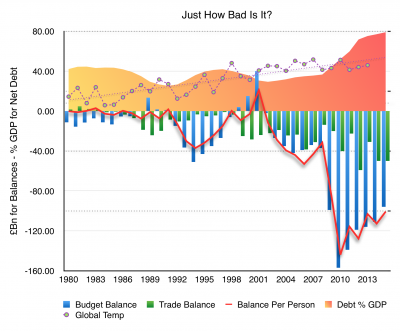
After the next financial crisis, and the break down of “middle class” expectations, it will seem incredible that we did not see it coming. Unprecedented levels of financial debt, never balanced budgets, massively unbalanced trade, and millions of humans consigned to the margins of society: these are well known and completely visible facts about our society. We are living in a house of cards, and this house will fall before the following general election.

The UK’s general election could be tame compared to what happens in Europe in the coming half-decade, where populist movements from the left and right will dis-integrate what we currently call the EU into a shadow of its current state. (Of course there’s also the very real possibility that the UK will break up or leave the EU after this election.) A combination of pressures related to energy, trade, immigration, solvency, and demographics will transform the cozy into the crazy.

Debt increases 2007-2014Shifting trade and monetary winds around the world will make much of the current debt loads obviously unsustainable in the coming five years. Economic growth will not regain it’s pre-Crisis levels, and combined with generalised deflation, the debts of all but the most secure will crumble into default. There is not enough safety on earth to provide havens for the all the liquid cash in the world, and it is too late to regulate the flow of capital or shore up the weak.

By the next time the UK goes to a general election we will have double or treble the unemployment, a hole in the budget the size of the NHS that we cannot fund through more borrowing, and the reality, that is already obvious now, will have become inescapable.

So enjoy this little charade through May. Worry about the little things, and agree not to discuss the bigger things. Latch on to the good news, and ignore the facts. This will be your last chance to do so, and seeing as pretty much everyone is on board with the story, you may as well enjoy the ride.

Categories
ConDem debt Democracy politics society

Malaise afoot

There is malaise foot, people sense it, and without sensible alternatives they will increasingly gravitate to the simplest and most self-protective options that are available. This political malaise has a short horizon, even if any one of a dozen potential powder-kegs does not go off to shorten it further (a debt crisis in next 3 years being the most likely).
3 deficits_0

Living life, private or public, off debt is an instinctively unstable position, and we are all aware of our deep financial, social, and environmental debt – for which we have no repayment plan. Individuals in this situation commonly, and understandably, abscond, turn criminal, and rage against the system. For individuals in a decent society we have the rule of law to provide a way out of such situations, for whole societies there is no such rail to lean against. This is the story of the evolution of human societies, and the unfit pass into history.

Without the appearance of a practical, credible and safe path forward, today’s advanced societies are pressing into a breach left open by the failure of both centre-left and centre-right politics to apprehend the dire need for such a path.

Categories
change citizen Democracy politics WellFair

Making Progressive Politics Work

In an excellent collection of essays the Policy Network has collected together for their “Making Progressive Politics Work” publication, we found the following comments by various authors in support for the fundamental principles that LIFE’s policies are based on.

Categories
economics Key Article politics

First new economic model in 100 years

The battle to figure out how to afford the society we want is the political challenge of our generation. Solving that problem reveals the first new economic model in 100 years.

On the one side we have those demanding better social support, and on the other there are those who see the only workable option as NeoLiberal Puritanism. Because it looks unaffordable to have decent social support, one side invents “magic money” to pay for it, and the other side says that we simply can’t afford it. They are both ignoring reality because they don’t see any other option, but there is.

Key Features of the New Economics

  • Universal safety.
  • Distributed democracy.
  • Personal privacy.

Love_PumpInvesting in the infrastructure for universal social safety creates a more dynamic, lower cost economy that is fiscally, socially and environmentally sustainable with low growth.

The recognition that social safety is a parallel requirement for economic success, and the revelation that unconditional safety is both the natural expression of solidarity and the key to liberating economic performance, has unveiled a new economic model for human society that will transform the 21st Century into a new age of enlightened prosperity.

Categories
economics Key Article politics WellFair

Conditional Cash Corrupts Us All

Why cash has (almost) no place in a social security system.

Unconditional love is the ultimate expression of our humanity for a reason, because it is the basis of our successful evolution.

The purpose of social security is to provide unconditional support as the expression of solidarity, thereby maximising the output and the quality of our society. Conditionality defeats the central purpose of providing social security, corrupts all participants, and stultifies our society and its economy. Because cash distribution always includes conditionality, it has to be removed from social security.

Categories
environment politics

What does it mean to be a “green progressive”?

Too often those of us that consider ourselves to be part of the progressive movement, are too easily satisfied by feeling good. Feeling good is part being right, meaning that we feel we are speaking the truth, and part feeling that we are on the correct moral side of an argument.
But progress is a description that includes movement, and surely is really measured in terms of the ability to be effective in moving forward. Feeling good is a stationary state of affairs, the more fundamental question is how do we move forward? If we know the truth and we know the correct moral side of an argument, how do we then move forward to making that a reality? The true measure of a progressive should be the efficacy of the effort to progress.

Categories
budget ConDem debt politics problems

UK policy: trapped behind the yield curve

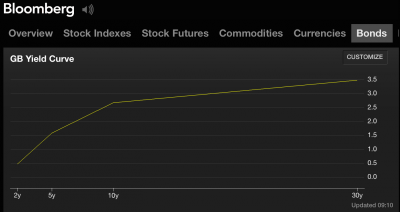
If you want to understand why all of the major UK political parties are committing to essentially the same fiscal strategy, i.e. reducing borrowing to zero by the end of the next parliament, then you’re going to have to understand what the “yield curve” is.

yield curveThe “yield curve” is a line drawn on a graph connecting the different interest rates that the government has to pay to borrow money over different periods of time. For the UK this is quite a steep curve, because our short-term interest rates are much lower than our long-term interest rates. To borrow money for two years at a time we pay about 0.5% a year, but to borrow money for 10 years we would have to pay around 2.8% per year. That means we have to pay five times more in interest if we want to borrow money that we will repay in 10 years from now, compared to money that we borrow and say will we will repay in 2 years from now.

Fairly obviously, as a result of this steep yield curve, the UK Treasury benefits from shifting its borrowing to much shorter term “gilts” (average gilt maturity has shortened by 5 years in the last 4 years, from 14 years in 2010 to 9 years today – see table below), because it is so much cheaper to borrow money over the shorter period. The logic is that if we are unable to repay that debt at the end of the shorter term, then we simply issue new short-term debt (gilts) and use that money to pay off the previous gilts.

Understanding2So why are the U.K.’s interest rates to borrow money over the short term so much lower than they are over the long term? The reason is because, over a two year time horizon, lenders have a fairly high degree of certainty that the existing government policy will be enacted, and budgets met. But given the size of the overall fiscal problems for the UK government (we have a very high ratio of debt to GDP, and we have a higher level of annual borrowing to meet current spending, at about 6% of GDP, which is twice the limit set on Eurozone countries’ maximum borrowing), lenders have a much lower degree of confidence about how the UK is going to eventually bring its fiscal situation under control.

When lending money to the UK for just two years, lenders only have to evaluate whether the current set of tinkering measures will or will not be implemented, and they don’t have to care about whether the long term situation will be resolved or not.

Categories
change ConDem economics enterprise labour politics

Snakes can’t jump

Snakes can’t jump – why voting Labour in the next election won’t make any difference

“Lemmings, left!” ~ heard from the back of the pack as they hurtled towards the cliff.

Across the industrialised or ‘advanced’ world there is a dearth of new ideas and a consequent absence of solutions for, and discussions about, the real problems facing us.

Our demographics are approaching post-industrial new normals. Our economies are still dependent on exploitation of resources or labour, or both. Our societies are structured to combat the scourge of parochial narrow-mindedness, but not take advantage of inter-connected communities.

The existing political parties are devoid of brilliant thinking in the face of enormous challenges, offering 20th C, or even 19th C, solutions for our 21st C problems. Neither “growth” on a finite planet (with increasing competition for resources), nor simply paying ourselves more, nor the white knights of private enterprise are 21st C ideas let alone solutions, and the general public knows this.

We stand before the chasm of the next financial calamity, dressed only in our grandfathers’ long johns. We need fresh thinking that leverages the modern world and all of the opportunities that can only be ours in the 21st C because we have the benefits of the industrial, technological and information revolutions behind us.

We cannot afford to go into the next election like we are now.

Central to our legacy political parties’ internal problems and the disconnect between their policies and reality is their failure to grasp the true nature of human society, and our evolution in the continuum of this planet.

“Business” is a classic example of this disconnect. Neither left nor right places this vital human function in its appropriate context. The left has traditionally seen the economy in terms of objective components to be arranged on a chessboard, but not understood in any meaningful way. New Labour was simply a capitulation to the traditional right-wing perspective, which recognises the “animal spirits” inherent in business activity and in the economy, but does nothing to understand context.

Pushed to the limits of their policy framework, confronted with its evident failures, both sides tends towards the notion that businesses can be seduced or encouraged into fulfilling a social responsibility. This is a fundamental misunderstanding what business is, it is the equivalent to suggesting that snakes can jump. (Indicative of this problem was the response I received once to a posting in a comments section where I suggested that snakes couldn’t jump, in which the responder said that snakes could jump, and that they did have legs, and that our responsibility was to help snakes understand that they did have legs.)

A decent and functional understanding of the true nature of life recognises that “business” is a term we used to refer to a perfectly natural set of behaviours that are related to living in a resource and time constrained world with many various needs. And as a natural set of behaviours the correct approach is to understand their context and function, rather than trying to suggest that they should be redirected in some other direction. Once a set of behaviours has been understood in its context, then one can determine if those behaviours become inappropriate because they have left their natural context. This understanding is completely absent from both left and right, without that understanding both of our legacy parties employ, deploy and allow business to operate outside of its context, with negative results for our entire society.

These parties, whose foundation for policy is so pathetically absent of real understanding, are completely useless at developing solutions to our problems. The Conservatives will attempt to deploy snakes everywhere, and when confronted with its failures, they will suggest that they are training a new subset of the species that has legs. Labour will draw lines in the sand, and tell the snakes that they are only allowed in certain areas, and that there are certain of the lines over which they must jump. It’s madness either way. 

And this is but one example of where our legacy parties are completely failing to grasp the real issues. Frankly, it doesn’t make any difference which one of them you vote for, none of them is actually going to solve any of the problems.

Choose LIFE!

Categories
Key Article legacy parties politics problems

The emperors have no clothes!

Why start the LIFE party? Does the UK need a new political party?

YES!  We all know about the problems we face, and their magnitude: we are living beyond our means, barely getting by as it is, and facing waves of change in the coming decade that will challenge every human society on Earth.

LIFE-Love-Vote-logo-848To address these problems honestly, we have to really change. We will have to change the way we live, the way our economy works for us, the way we make decisions, and how we take care of each other. And we must arrive at this new destination soon: a place where we are happy to live, where we are safe, and where we are in balance with the natural world that sustains us.

Not one of the existing political parties in the UK has a plan to get us to the destination we need to reach.